Sunday, April 17, 2011

How to Get Your Work Into an Anthology

Here's a great article by Karina Fabian that will help those of us who are interested in getting their work published in an anthology.

I’ve been on both sides of the anthology fence—having had stories published in several anthologies from Firestorm of Dragons to The Zombie Cookbook—as well as having edited three anthologies, the latest of which is Infinite Space, Infinite God II. (www.isigsf.com). I enjoy anthologies for a number of reasons—I like having my stories in a book, I like reading anthologies myself, and they are a lot of fun. However, they are a competitive market, just like all writing markets these days. Here are some things I’ve learned from being on both sides of the fence that can help you get in.

#1 Network: Join some writers groups that are tied to your genre or interest. Most of the anthologies I’ve been in, I’ve heard about from Yahoo groups or The Writers Chat Room. It’s also been an aid, since the editors are usually members of the groups, too. Duotrope.com and ralan.com also list calls for submissions, so check them out regularly.

#2 Read the Guidelines. You’d think this would be obvious, but it isn’t. I see editors complain about it, and as an editor, I’ve tossed out stories after the first paragraph because the writer sent me a fantasy for an SF anthology. Sorry, guidelines are there for a reason.

#3 Understand the SPIRIT of the anthology. Anthologies are not like magazines, that can take a wide range of stories. They usually have a specific theme or purpose. If you do not address that theme or style, it does not matter how good your story is. A bad fit is a bad fit. Here’s a good example for ISIG II: We stated that our intention in the anthology is to show the positive portrayal of the Catholic faith and science, and of them interacting in concert. Naturally, non-Catholic Christian stories didn’t fit. But even worse was the story that started out painting priests as evil and the Church as uncaring. Now, I’m not going to argue anyone’s personal beliefs here, but how in the world is that the POSITIVE?

#4 Be ready to accept some editorial direction. Editors are interested in making the stories the best they can be. Editors of anthologies need to think not only of the story but how the story fits the whole. That may mean some changes—in length, in prose, in style. Obviously, you don’t want to change your entire story into something unrecognizable, but do consider accepting direction—or losing your chance at the anthology. In ISIG II, for example, we wanted the portrayal of the Catholic Church to adhere to Catholic teachings and beliefs, and had to ask for some changes in order to do that. We were blessed with professional authors who were glad to do it.

#5 Regardless of how you’re paid for the anthology help promote it. Unlike a magazine, anthologies do not have a set audience. Like books, they need promoting. You’d think that an anthology would have a whole team behind it, but in reality, usually only the editors and one or two interested authors are doing the grunt work. It doesn’t to take much—mention it on Facebook, post the summary and link on your website, send out a press release, and ask folks to review it. Work with your editor. I can tell you from both sides of the editing fence, it’s much appreciated.

Anthologies are a lot of fun—and they are a lot of work. It’s a great opportunity for promoting yourself, reaching other audiences, and hooking your star to other great writers. Take advantage of the opportunities they present.

Karina's work on Kindle is available for these special prices for the dates specified: Infinite Space, Infinite God: $.99 April 9-13; $2.99 April 14-23. Infinite Space, Infinite God II: $2.99 now through April 23. Better hop on these deals. You'll be glad that you did!

Thursday, April 14, 2011

What's Up, Holmes, says Dr. Watson


There’s No Holmes like Holmes

I read my first Sherlock Holmes story in my junior year of high school. I hated high school, was longing to be rid of it, and I was going through all the books in the house simply looking for something interesting to read that would take me away for a little while. I’d read all of my mother’s Agatha Christies, so she suggested reading The Hound of the Baskervilles. And….in a fashion uncharacteristic of most teenagers, I did.

In the opening pages, Holmes asks his friend Dr. Watson to analyze a walking stick left behind in their rooms by someone who had visited while they were out. Watson makes some observations about the stick, guessing about the owner. Holmes then takes the stick and shows Watson how he was completely wrong in all of his deductions.

I loved this character already!

But it only got more interesting when that visitor returned and told the Holmes and Watson about the legend of the hound of Hell who haunted the Baskerville family, and how the late Sir Charles Baskerville was found dead with footprints of a giant hound beside the body. I couldn’t put the book down and was utterly frustrated when Holmes “vanished” partway through the book, leaving Watson to investigate the situation in Dartmoore, only to appear suddenly later having been spying on the whole situation from afar.

Now – I relate a bit of the play-by-play on my first reading of Sherlock Holmes to make a point. Teenagers and sometimes pre-teens (if they have a decent vocabulary or the tenacity to look up words in the dictionary) can read the original tales written by Sir Arthur Conan Doyle. Teenage boys were, after all, his intended audience, and most of his readers at the turn of the last century were young people.

And yet there are new young-adult series starring the Sherlock Holmes character. I’ll mention specifically the Enola Holmes series by Nancy Springer as well as the Young Sherlock Holmes books by Andrew Lane. While both of these series have received critical acclaim, and I don’t fault the authors for writing Holmes books (I mean…I just have to look in the mirror), I just have to wonder, why not simply offer kids the original Holmes stories first? I have freshmen in my high school classes who have read and enjoyed Holmes, and I’d say from age 14 years up, they can usually manage.

For first-time readers, I recommend short stories first. The tales I usually suggest are: “The Red Headed League,” followed by “The Blue Carbuncle” (especially around Christmas time), “The Speckled Band,” “Silver Blaze,” “The Greek Interpreter,” and “The Dancing Men.” After these, “The Final Problem,” and “The Empty House” can be read as a set. One could then progress to other stories and the novels, of which The Hound of the Baskervilles is the best.

Even better….all of these stories can be tried without plunking down money. They can be found online right here complete with the original illustrations! That way, if a young reader likes all the original tales, they can invest in a great hard copy and then move on to the stories written by other people who simply loved the character enough to keep telling stories about him, like, say….me.


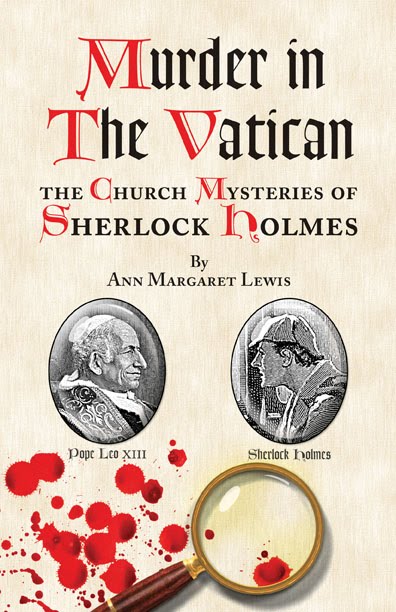
Summary of Ann's latest release, Murder in the Vatican: A sudden death in the Vatican. An international incident over stolen artifacts. A priest’s wrongful imprisonment for murder. In this collection of three as yet untold tales, hinted at in the original Holmes stories, the voices of Dr. John H. Watson and the legendary Pope Leo XIII reveal how the great Sherlock Holmes brought these grim ecclesial cases to startling and poignant conclusions.


And here's some more information about Ann! Born and raised in Waterford, Michigan, Ann Margaret Lewis attended Michigan State University, where she received her Bachelor's degree in English Literature. She began her writing career writing tie-in children’s books and short stories for DC Comics. Most recently she published a second edition of her book, Star Wars: The New Essential Guide to Alien Species, for Random House.

Her latest book is Murder in the Vatican:The Church Mysteries of Sherlock Holmes published by Wessex Press. She is also co-writing a historical novel entitled Roman which tells the true story of a priest in 1840s southern Indiana who was accused of assaulting a woman in a confessional.

Ann has many interests from music to art history, to theology and all forms of literature. She is the President of the Catholic Writers Guild, an international organization for Catholic Writers and the coordinator of the Catholic Writers Conference LIVE. Ann lives in Indianapolis, Indiana with her husband Joseph Lewis and their son, Raymond.


Watch her You Tube video here. You can purchase her book through Amazon or directly from her publisher. To learn more about Ann and her writing, visit her website.

Thursday, February 17, 2011

Writing Books for Children and Young Adults that Will Sell


I'm pleased that Jacqueline Seewald has come to share some of her expertise with us today. Jacqueline is a multi-award winning author who writes for adults as well as teens and children. She has taught creative, expository and technical writing at the university level as well as high school English. Ten of her books of fiction have been published. Her short stories as well as poems, essays, reviews and articles have appeared in hundreds of diverse publications and numerous anthologies. Her adult mystery novel, THE INFERNO COLLECTION, was published by Five Star/Gale in hardcover in 2007 and Wheeler large print in 2008. Another novel, THE DROWNING POOL, was published in 2009. The third mystery in the Kim Reynolds series, THE TRUTH SLEUTH, will be published in May 2011. A young adult novel, STACY’S SONG, was published by L&L Dreamspell in November 2010.

Even before J. K. Rowling's tremendous success with her Harry Potter series, publishers were searching for fantasy and horror fiction for children and teenagers that they hoped would top the bestseller list. Imitation may be the sincerest form of flattery, but it does not insure success as a writer. Not every juvenile book needs to feature werewolves, vampires, witches or goblins.

Books set in the "real" world still have appeal for teens and children. Young readers are not necessarily trying to read books that provide a total escape from reality. Even fantasy books need to be believable, provide an element of reality through character development to which readers can relate.

One of the most important things in writing a successful young adult novel or children’s book is to develop a unique voice. That does not mean that you must write from a first person point of view. However, teen readers often respond well to a first person narrative.

It is important to create a central character that young readers can both sympathize and identify with. Whether writing realistic or fantasy fiction, if the reader can't care about or relate to the main character, than he or she won't believe or accept what follows.

Teens as well as younger children enjoy an element of mystery. Every good work of fiction should have a plot that keeps the reader turning the pages, wanting to discover what is going to happen next. It's important to set up some sort of a question that can't be easily or immediately answered, a secret of the human heart that must be delved into.

A word of warning: If you are going to write about teens, you must know about them. Do some research. Besides raising two teenagers, I taught English and later Library Science. I taught at all levels: the university, high school, middle school and elementary. But most of my years were in the high school. I am accustomed to the way teenagers think, talk and behave. If you are not a teen yourself, talk to teenagers, read their magazines, watch their favorite TV programs, observe how they behave at malls, amusement parks, movie theaters etc.

Dig deep into your own psyche. How did you feel as a teenager? My latest YA novel, STACY’S SONG, published by L&L Dreamspell in both trade paperback and e-book formats, is the story of a girl who has serious identity issues. Most of us have gone through similar problems as adolescents.

Get input from your own children. Have them read your writing and critique it. Consider collaborating with your children on the writing of your fiction. I wrote WHERE IS ROBERT?, a middle grades/YA novel with help from both of my sons who were teenagers at the time. Both boys contributed to the scenes of high school wrestling, since they both engaged in the sport. I couldn't have written the book without them.

Make it dramatic. Dramatize your story. Don't show, tell. I'm certain you've heard that advice before! How to do this? Create meaningful, realistic dialog for your characters. Each character should be an individual, talking a certain distinct way to reflect a personal point of view, a unique way of thinking. Good dialog leads to action and conflict between people with different viewpoints and goals.

Settings need to be vividly described so that they seem real. In fact, there's nothing wrong with using real places for background setting. My three published YA’s are all set in Central New Jersey, an area very much like the one in which I lived and have worked.

For my children’s picture book A Devil in the Pines, I created a faction story. I used the real setting of the New Jersey Pine Barrens and the legend of the Jersey Devil combined with the fictional story of a little boy who learns how to deal with fear. Afton Publishing has kept this book in print from its publication in 1999 to the present because it is a timeless story and therefore continues to sell well.

My advice, don't write for the market; write the story you need to write. We are all writers. We all have within us a unique, important, wonderful story to share. Get in touch with your inner self. Start putting your ideas on paper. Begin with an outline, then a rough draft with key characters and scenes. When you develop your book, look for depth. Although books for teens and children are usually shorter than those for adults, it doesn't mean they require less creative thought. Respect your readers; give them quality.